Talks & Presentations
Here you can find my talks and presentations, usually as "study circles" at physics department of SUT. These study circles are held at "Quanta Study Circles", somewhere I've revived after being disabled for a while and since then, many study circles were held there. You can find more information about Quanta on its webpage.
Historical Papers
Historical Papers is a study circle that in each session (almost monthly), the corresponding instructor presents a significant (usually almost groundbreaking)"historical" paper in physics.
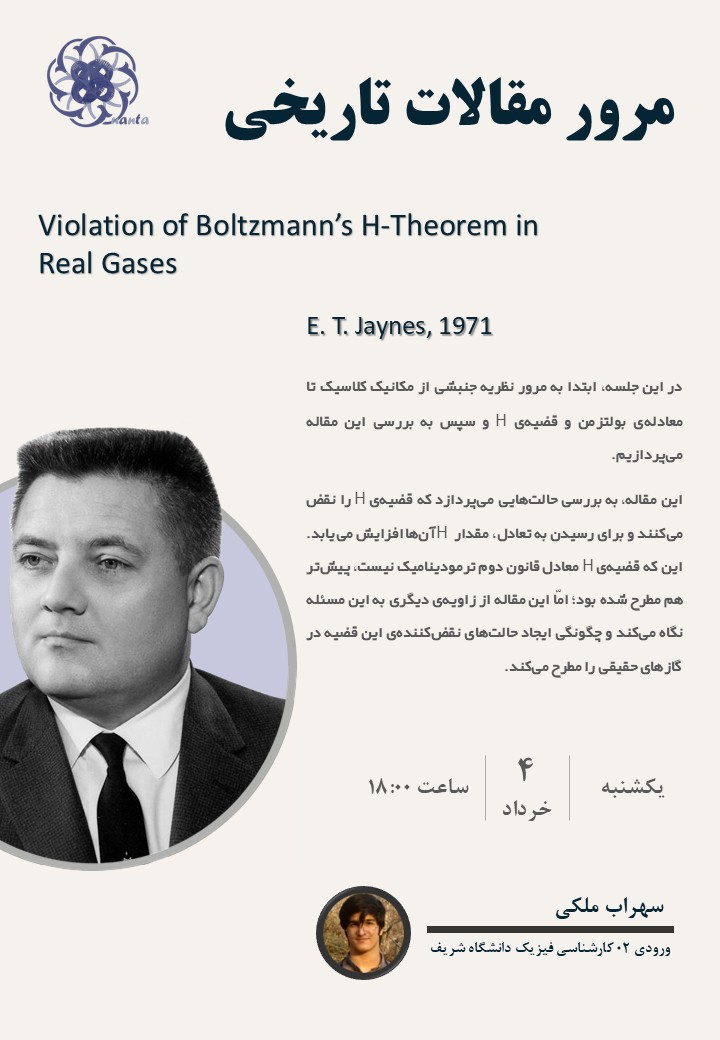
Quanta Study Circles, SUT, 25 May 2025
In this session, I first review the Kinetic Theory from classical mechanics to the Boltzmann's equation and H-Theorem and then, investigate this paper.
This paper investigates the "H-Theorem-violating" states which increase their H function in order to obtain the equilibrium. The fact that H-Theorem is not equivalent to second law of thermodynamics was previously pointed out; but this paper investigates these states in such a way that one can "produce" those states in an actual lab.
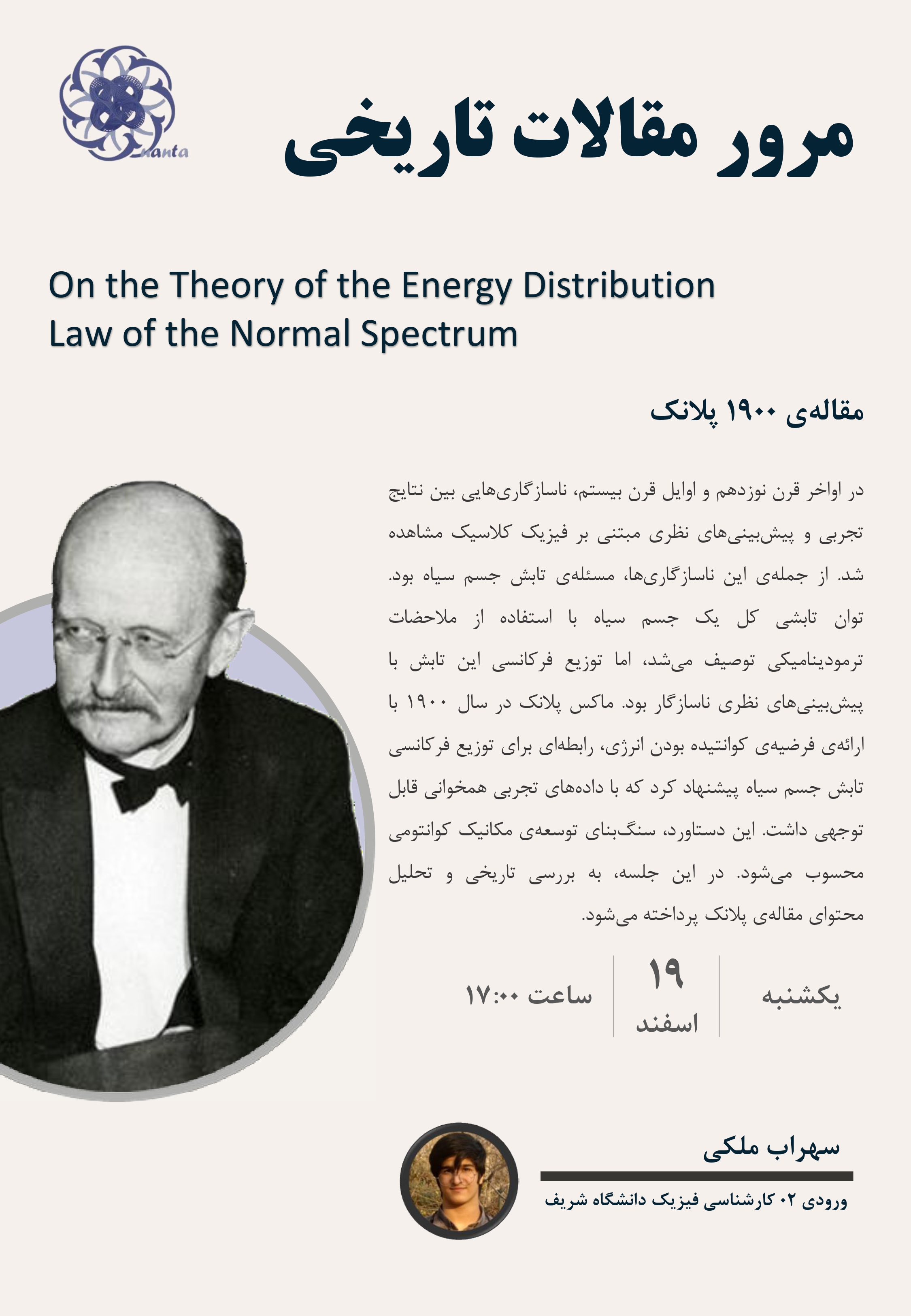
Quanta Study Circles, SUT, 9 March 2025
In the late 19th and early 20th centuries, discrepancies were observed between experimental results and theoretical predictions based on classical physics. Among these discrepancies was the problem of black-body radiation. The total radiative power of a black body was described using thermodynamic considerations, but the frequency distribution of this radiation was inconsistent with theoretical predictions. In 1900, Max Planck proposed a relationship for the frequency distribution of black-body radiation by introducing the hypothesis of quantized energy, which showed significant agreement with experimental data. This achievement is considered the foundation for the development of quantum mechanics. In this session, the historical context and content of Planck's paper will be examined and analyzed.
Quantum Theory
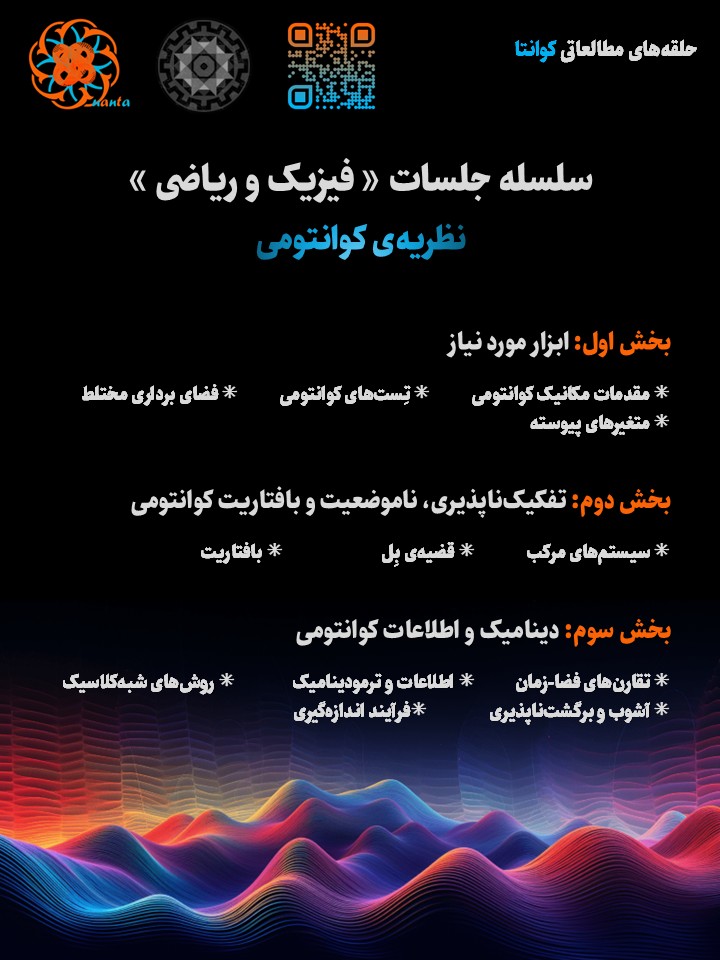
Quantum Theory is a study circle in which covered a brief review on the pragmatic meaning and an extensive discussion on foundations of quantum mechanics. It is desired to entirely cover the topics of a book written by Asher Peres. Here's the content I wish to cover by the end of the circle: Part I: *Introduction to Quantum Physics *Quantum Tests *Complex Vector Space *Continuous Variables Part II: *Composite Systems *Bell's Theorem *Contextuality Part III: *Space-time Symmetries *Information and Thermodynamics *Semiclassical Methods *Chaos and Irreversibility *Measuring Process. You can also see the playlist of these set of lectures in my youtube channel.
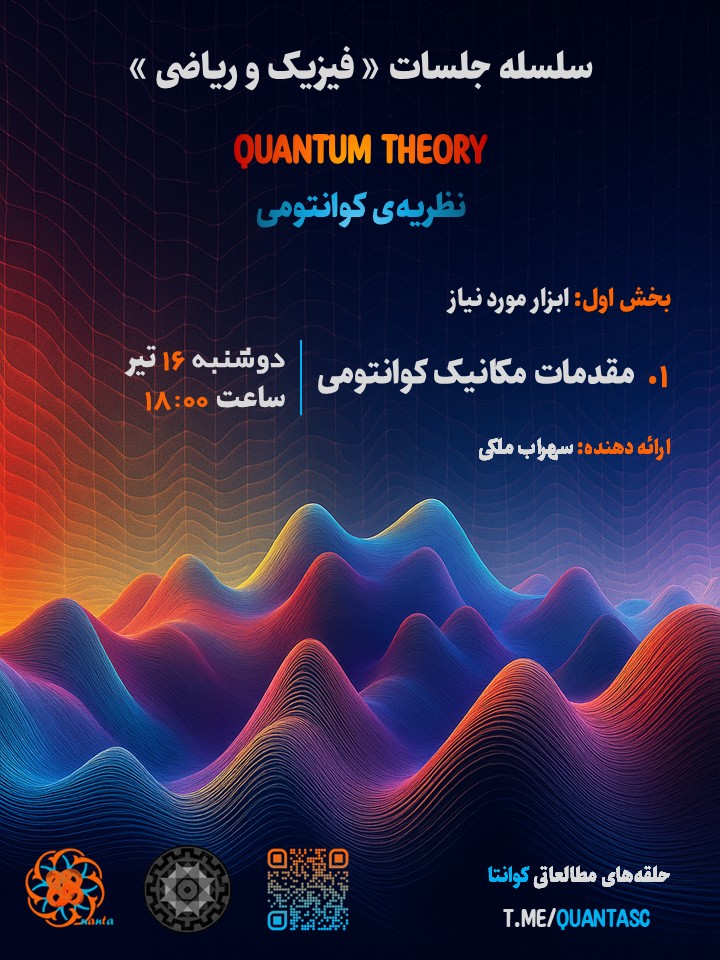
Quanta Study Circles, SUT, 7 July 2025
In this lecture, I talked first about the purpose, preliminaries, mathematical level, etc., the general layout of the study circle and begun the introduction to quantum theory. This is done by considering quantum phenomena of light. Here's the references of this session:
[1]: M. Planck, Verh. Deut. Phys. Gesell. 2 (1900) 237; Ann. Physik 4 (1901) 553.
[2]: A. Einstein, Ann. Physik (4) 17 (1905) 132; 20 (1906) 199.
[3]: G. N. Lewis, Nature 118 (1926) 874.
[4]: A. H. Compton, Phys. Rev. 21 (1923) 207, 483, 715.
[5]: W. Heisenberg, Z. Phys. 43 (1927) 172; The Physical Principles of the Quantum Theory, Univ. of Chicago Press (1930) [reprinted by Dover] p. 21.
[6]: C. Davisson and L. H. Germer, Phys. Rev. 30 (1927) 705.
Quanta Study Circles, SUT, 9 July 2025
In this lecture, I've completed the "Introduction to Quantum Physics" and have defined the primitive notions of quantum theory. Here, I defined the primitive concepts "Preperations" and "Tests" which can not be defined in term of more primitive notions. Then I defined Quantum Systems, Quantum States, Repeatable Tests and Maximal tests. Here's the references of this session:
[1]: W. Gerlach and O. Stern Z. Phys. 8 (1922) 110; 9 (1922) 349.
[2]: N. Bohr, Phys. Rev. 48 (1935) 696.
Quanta Study Circles, SUT, 13 July 2025
In this lecture, I've discussed the interference postulate and its necessity in order to make the theory self-consistent. Then, formulated only the "experimental observations" and showed how matrices (and linear algebra as a whole) are well candidates for being used to formulate the theory. Transition amplitudes are defined and "chosen" to form unitary matrices (using the phase/gauge freedom). Up to now, nothing has came out of nowhere (and no wavefunction or state "vectors" have been defined or postulated). In next session, We use the advantage of linear algebra and define all these mathematical objects for convenience. Here is the references of this session:
[1]: A. Landé, Foundations of Quantum Theory: A Study in Continuity and Symmetry, Yale Univ. Press, New Haven (1955).
[2]: Y. Aharonov, P. G. Bergmann, and J. L. Lebowitz, Phys. Rev. 134B (1964) 1410.
[3]: H. Poincaré, Théorie mathématique de la lumière, Carré, Paris (1892) Vol. II, p. 275.
Quanta Study Circles, SUT, 23 July 2025
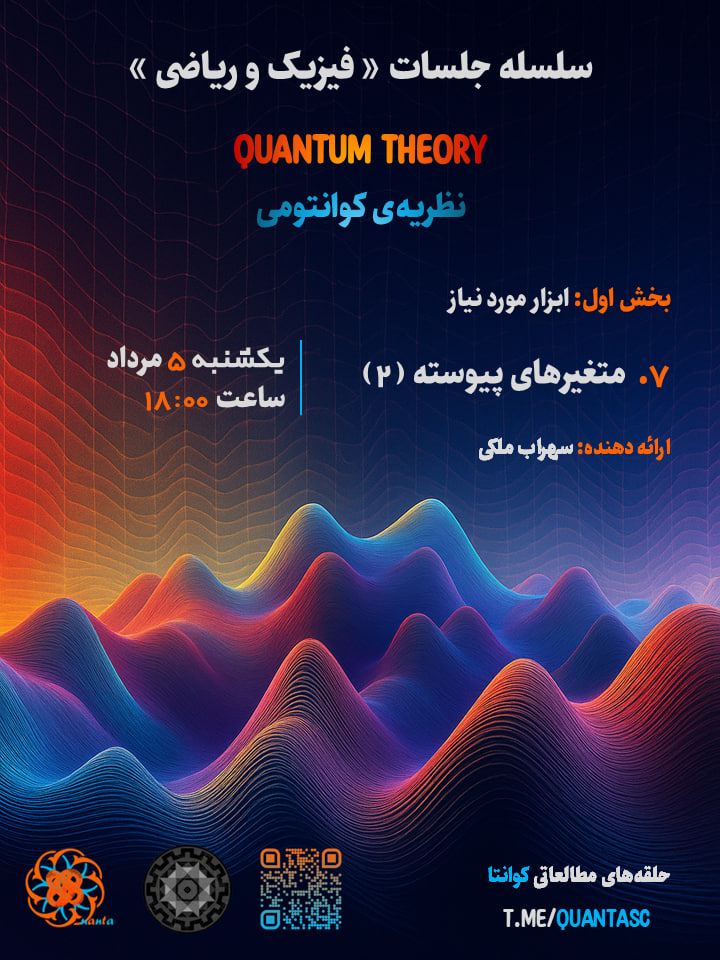
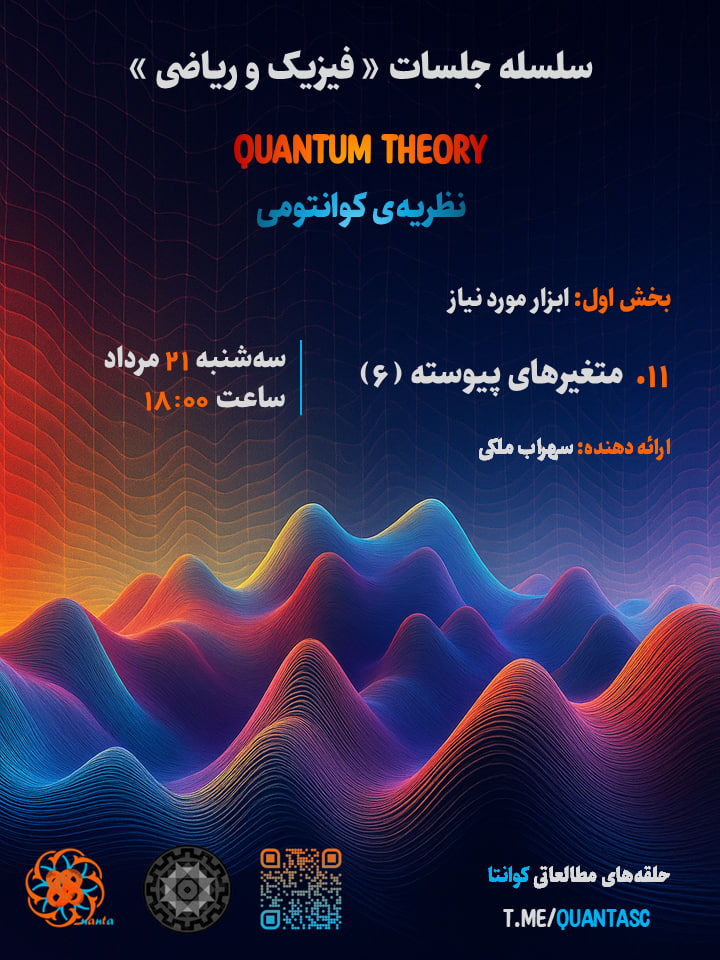
In this lecture, I've ended the fomulation of Quantum Theory of a quantum system by formulating the quantum mixtures using density matrix and investing its properties (and show how it is evaluated in practice). Then, I've began ``Continuous Variables"; This is not a complete, mathematically complete investigation of continuous spectra from mathematical zero point. But we mention some common issues appear (with physical consequence) if one ignores mathematical rigor. In this lecture, I've shown some difficulties of generalization of finite-dimensional matrices to infinite dimensions and discussed strong and weak convergence.
Quanta Study Circles, SUT, 27 July 2025
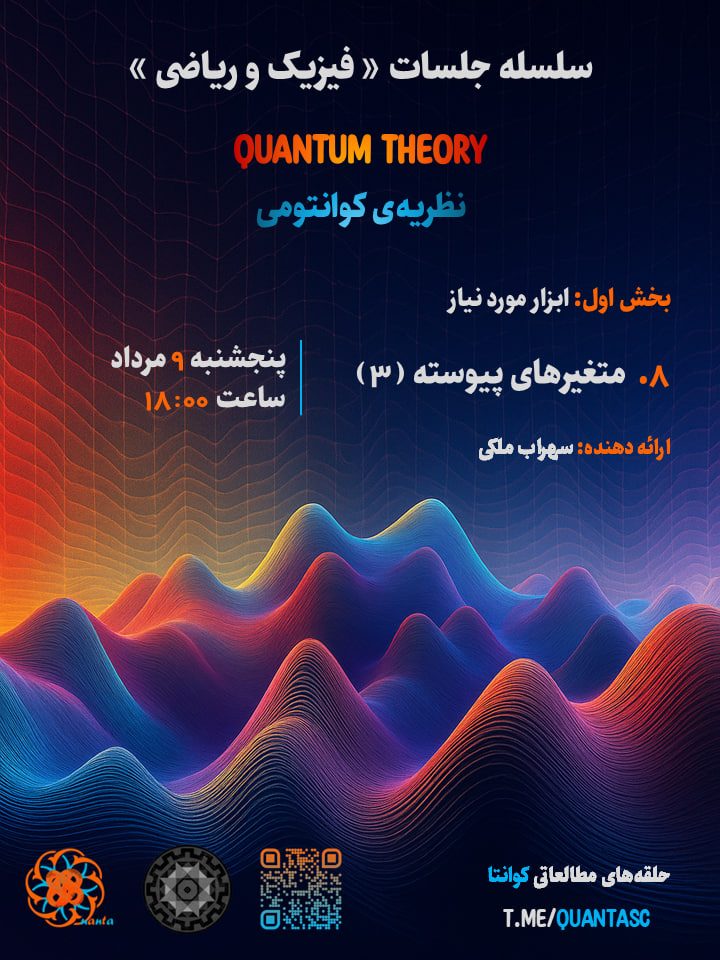
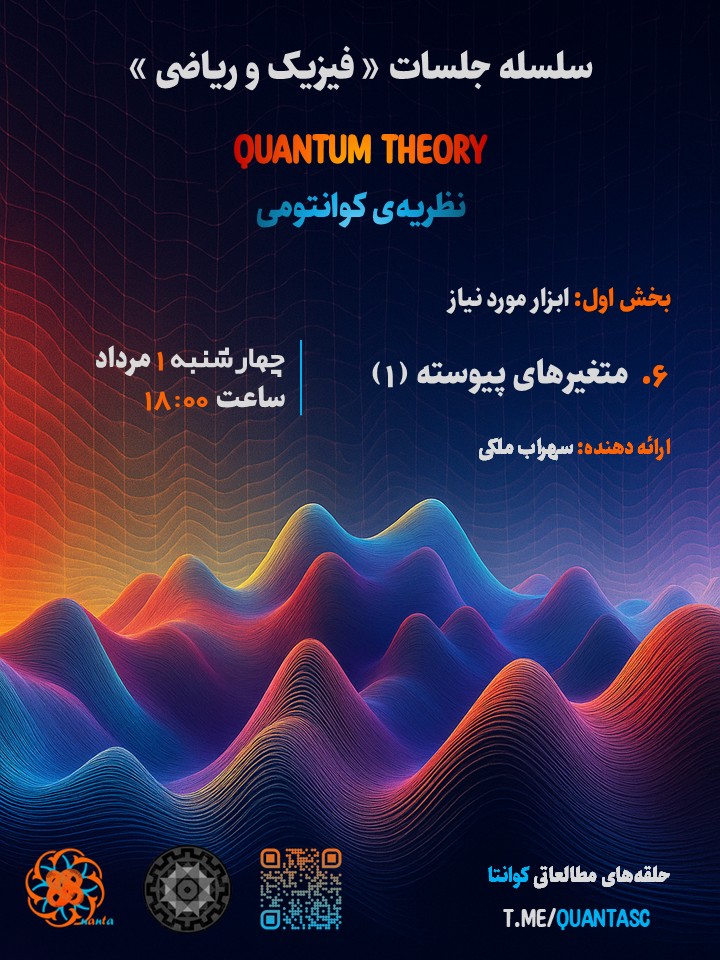
In this lecture, I've briefly reviewed the notion of ``propagators" because of its application (we'd back to this in chapters related to quantum dynamics) and showed that Hilbert space unavoidably contains discontinuous wavefunctions. We've actually shown that the Schrodinger equation itself, can evolve a continuous, differentiable, square-integrable function into a discontinuous one! then talked about the notion of ``separability" of a Hilbert space briefly (because quantum mechanics doesn't have to do anything with this. The relevant difficulties arise when dealing with quantization of fields).
Quanta Study Circles, SUT, 31 July 2025
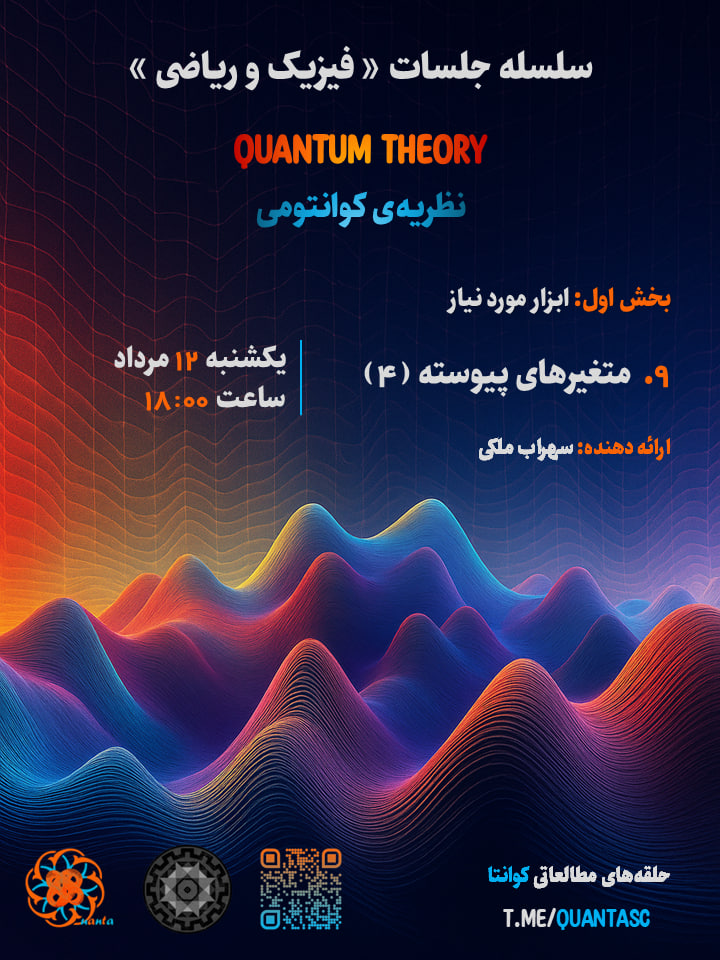
In this lecture, I've discussed linear operators. I begun by showing that how some innocent-looking finite-dimensional matrices cannot make sense when generalized to infinite dimensions and motivated the ``Domain of Definition" and ``Boundedness" of an operator. Then, defined adjoint operation and the notions of ``Self-Adjoint" & ``Symmetric" operators (and their difference!). Then, I show that momentum operator is not symmetric nor self-adjoint when defined on a finite region! unless it is defined on certain functions satisfying a boundary conditions.
Quanta Study Circles, SUT, 02 Aug 2025
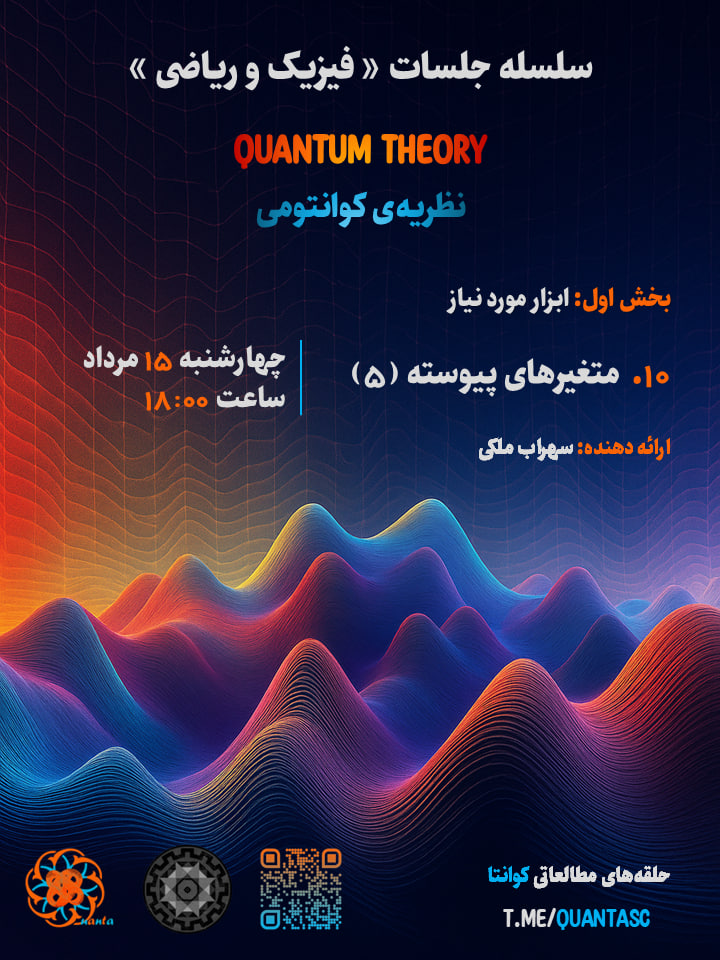
In this lecture, I've shown that it is possible to upgrade some symmetric operators to self-adjoint ones by expanding their domain of defitnition through an example (momentum operator in finite region). Then investigated their physical significance and how their show-up in Aharonov-Bohm effect. Then, I've shown that this is not always possible (with a simple counter example: radial momentum) and some symmetric operators cannot become self-adjoint in any ways! Now, we've delved into uncertainty relations. I've reviewed the formal derivation of them to be aware of mathematical assumptions behind each step for futher investigations.
Quanta Study Circles, SUT, 06 Aug 2025
In this lecture, I show how the ``minimum uncertainty" state can be derived and show that this is the cohearent state for momentum and position uncertainty. Then show that there's no such an uncertainty between angular momentum and angle operators because the mathematical assumptions in deriving uncertainty relations do not hold in this case. Then I show other difficulties arised by continuous spectra in commutation relations. Finally, I show that continuous operators do not have eigenvectors at all! but since we've defined measurements outcomes as eigenvectors, this is a serious difficulty that must be resolved. I've introduced the method which ``truncates'' the Hilbert space in order to approximamte the actual infinite-dimensional Hilbert space by a finite-dimensional one (which doesn't have such difficulties). But it will turn out that trunction method (which is notably successful in chemical physics), has unfortunate results and cannot be considered as an appropriate way to deal with continuous variables.
Quanta Study Circles, SUT, 14 Aug 2025
In this lecture, I first introduced briefly the ``Generalized Functions" and correct treatment of dirac delta function and that it can differ from Dirac's graphical description. Then, I begun to formulate the quantum theory of composite system, demonstrated quantum correlations (enganglement) and how it fundamentally differs with its classical counterpart (classical correlations).
Kinetic Theory
Kinetic Theory is a study circle that has covered topics on the Kinetic Theory in an intensive series of online sessions presented by me. The main reference is [1] but I've been looked briefly over other references to gain an overview.
[1]: D. Tong, Lectures on Kinetic Theory, University of Cambridge Graduate Course, 2012.
[2]: V. Karimipour, Thermodynamics and Statistical Physics, Sharif University of Technology.
[3]: R. Soto, Kinetic Theory and Transport Phenomena, Oxford University Press, 2016.
[4]: L. D. Landau & E. M. Lifshitz, Course of Theoretical Physics, Vol. 10: Physical Kinetics, Pergamon Press, 1981.
You can also see the playlist of these set of lectures in my youtube channel.
Quanta Study Circles, SUT, 19 March 2025
In this lecture, I investigate the Transport Phenomena. I begin with the mean free path; Then I turn to the Random Walk problem and consequently express the diffusion, fomulate the viscosity and finally, thermal conductivity using elementary kinetic theory methods. This session was the end of "Elementary Kinetic Theory" topic.
Quanta Study Circles, SUT, 23 March 2025
In this lecture, I review classical mechanics (and a bit of thermodynamics). This builds a comprehensive mathematical structure to beginning the treatment with the dynamics of many body systems (what we aim to reach in kinetic theory).
Quanta Study Circles, SUT, 25 March 2025
This lecture is the start of the advanced kinetic theory. In this lecture, I begin with Liouville's equation and formulate the BBGKY hierarchy. Although, as we show, it doesn't make life any easier than Liouville's equation, It's the way we reformulate the general problem in a way that is comprehensive for approximation methods.
Quanta Study Circles, SUT, 27 March 2025
In this lecture, I begin the investigation of Boltzmann's equation. In this series of sessions, we cover two approaches to Boltzmann's equation: A more easy-going approach and another more rigorous way. In this lecture, we cover the first approach. Throughout the investigations, we would be relied on Boltzmann's equation for many purposes.
Quanta Study Circles, SUT, 30 March 2025
In this lecture, I begin to discuss detailed balance condition and how the collision integral is the tendacy of the many body system to Boltzmann distribution by producing the Maxwell-Boltzmann distribution for an ideal gas. Then, I turn into the Quantum version of Boltzmann equation and finally investigate a better derivation of Boltzmnann equation starting from the BBGKY hierarchy.
Quanta Study Circles, SUT, 1 April 2025
In this lecture, I'd derive and discuss the so-called H-Theorem originally derived by L. Boltzmann. I demonstrate how the "molecular chaos" assumption is the key to irreversibility. Then I turn to general discussions about Fluid Dynamics, introduce collisional invariants and derive the master equation governing slow-varying quantities time evolution. There's also a recommended reading for this session: Violation of Boltzmann's H-Theorem in Real Gases.
Quanta Study Circles, SUT, 3 April 2025
In this lecture, I discuss the equations of motion in a fluid using the master equation derived for slow-varying quantities in the previous lecture. I show that these are not sufficient in determining the fluid properties. Then, I introduce the ideal fluid, extract its equations of evolution and show they miss dissipation. Then I demonstrate why.
Quanta Study Circles, SUT, 6 April 2025
This is the last lecture of the Kinetic Theory study circle. As we saw in the previous lecture, the ideal fluid misses dissipation (and therefore equilibrium). In this lecture I investigate how to include dissipation (through relaxation time approximation) and treat thermal conductivity and viscosity according to it. Finally, I'd derive the so-called Navier-Stokes equations governing the motion of viscous fluid.